Modern telephony and data privacy

Every call and text you send travels through layers of networks and tech you never see. Your phone number isn’t just contact info anymore—it’s part of your digital identity. That’s why phone privacy needs a serious upgrade.

At Anonyome Labs™, we believe telephony should be private by design. This article explains how modern calling works. It also discusses the risks of traditional systems. Finally, it shows how tools like MySudo® enable private communication.

What is telephony?

Telephony is the technology for transmitting voice (and now text and video) over a distance.

  • In the past, that meant analog calls over copper wires via the Public Switched Telephone Network (PSTN).
  • Today, calling goes beyond traditional phone lines. Voice, video, and messaging now happen over the internet, often called VoIP.
  • Telephony has shifted from circuit-switched connections to packet-switched data networks, enabling powerful features but also new risks.


Today, telephony includes:

  • Mobile calls over cellular networks
  • VoIP apps (calls, video, messaging)
  • Virtual phone systems
  • Privacy-first communication platforms

The risk of phone numbers as identity keys

Your phone number is no longer just a way to reach you—it reveals much more:

  • Phone numbers are linked to your name, address, and device in numerous systems (customer databases, directories, identity verification).
  • Scammers often exploit numbers via SIM swapping, spoofing, or vishing to hijack accounts or intercept codes.
  • When a user shares a phone number too much or exposes it, attackers can link it to other accounts and escalate their attacks.

They did not design traditional telephony for privacy. Scammers take advantage of this by leveraging phone numbers as an attack vector.

What is private telephony?

Private telephony is a system where your communication identity is separate from your real personal data. It also reduces exposure of that data. Key goals include:

  • Identity separation: Use multiple numbers for different facets of life (personal, work, transactions).
  • Strong encryption: Calls and messages that only the intended recipient can read.
  • Minimal metadata: Avoid storing or exposing who called whom, when, and how long.
  • User control: You—not your carrier—decide when to retire a number, block or mute contacts, or isolate communication.


With privacy-first platforms, you have communication control and maintain usability

How modern telephony works (simplified)

Era
Technology
Feature
Privacy Implication

PSTN / Landline

Circuit switching

Dedicated call line

Little to no encryption, full metadata exposure

Cellular (2G-5G)

Digital voice + messaging

Mobile voice, SMS

Networks log metadata, exposed to carrier vulnerabilities

VoIP / App Telephony

Packet switching

Voice, video, messaging over internet

Encryption possible, but metadata leakage still common

Private Telephony

Virtual + encrypted

Communication under control

Reduced metadata, identity separation, enhanced privacy
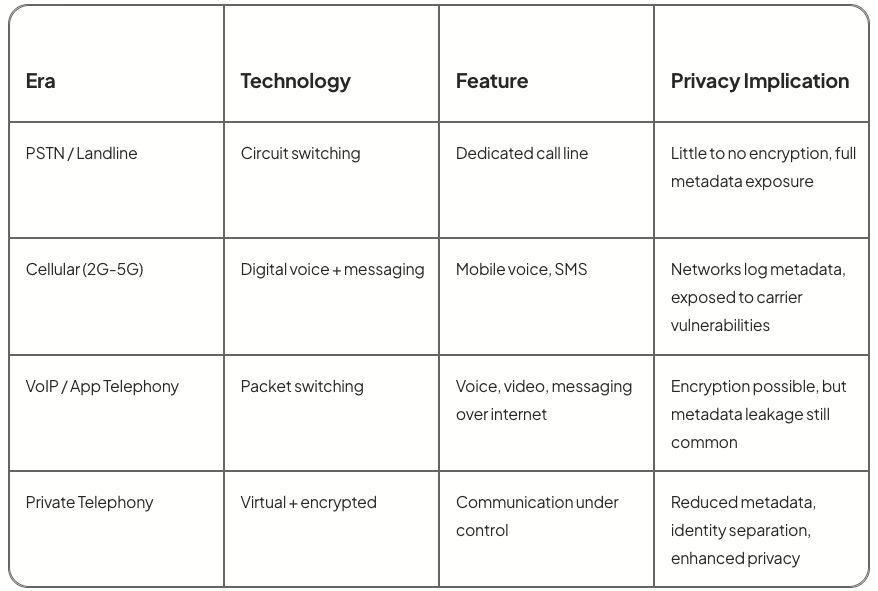
Telephony matrix

Modern telephony uses internet protocols to route voice and data—this enables flexibility (Wi-Fi calling, global reach) but also opens new attack surfaces if not secured.

Virtual numbers & cloud telephony

A virtual number is a phone number that doesn’t require a SIM or physical line. It routes its calls and texts over the internet.

Advantages:

  • Use multiple numbers on a single device
  • Discard or replace numbers easily
  • Isolate interactions (e.g., for online buying, dating, or customer service)


Considerations:

  • Virtual numbers must be coupled with privacy and encryption to avoid becoming another exposed vector.
  • They rely on internet infrastructure and secure back-end routing.


In a privacy-first telephony model, virtual numbers serve as safe overlays—protecting your real number and identity.

Common telephony threats

Here are well-documented risks facing modern telephony:

  1. SIM Swapping — Attackers trick carriers to transfer your number to a SIM they control.
  2. Vishing / Voice Phishing — Fraudsters impersonate trusted entities over calls to gather info.
  3. Spoofing / Caller ID Forgery — Faking caller details to trick recipients.
  4. Metadata Exposure — Even encrypted calls can leak call logs, durations, and participants.
  5. Carrier / Provider Breaches — Massive user data leaks, including phone databases.


A privacy-first telephony platform can prevent many of these threats. By bypassing carrier identifications and limiting data exposure, telephony platforms can ensure users stay safe.

Trends & future directions (what's on the horizon)

These are emerging directions in telephony worth watching:

  • Decentralized Identifiers (DIDs): Numbers may be replaced by cryptographic identity links you control.
  • Voice authentication & verification: AI and biometrics to prove authenticity and fight spoofing.
  • Encrypted metadata routing: Techniques for hiding call logs, durations, or participants.
  • Interoperability between private comms platforms: Seamless switching between apps without identity leakage.
  • Voice deepfake detection & prevention: Ways to spot and stop fake audio attacks.


While these are forward-looking, they represent the trajectory toward communication systems where users control identity, not carriers.

Quick stats about telephony

  • In June 2024, the U.S. had 65 million interconnected VoIP subscriptions out of 471 million retail voice telephone service connections (which include mobile + VOIP + traditional lines). FCC Docs
  • The Voice over Internet Protocol (VoIP) Services market was valued at US$ 112.9 billion in 2023 and is projected to reach US$ 263.0 billion by 2032. GlobeNewswire
  • Over 40% of VoIP calls worldwide are made via mobile devices. ZipDo
  • In 2024, more than 3 billion people were using VoIP globally. Electro IQ

How MySudo reimagines telephony

Here’s how MySudo® fits into a private telephony future:

  • Multiple private numbers (Sudos): Each Sudo number is isolated from your real identity.
  • Encrypted voice and messaging: Ensure that only the sender and receiver can access the content of their communication.
  • Block/mute and call control: Manage who can reach each number.
  • Metadata hygiene: Release minimal call logs or anonymize them to protect your privacy.
  • Number retirement / rotation: Safely discard or refresh numbers without affecting your real identity.

Telephony is evolving from a tool into a digital identity boundary. As voice, text, video, and data all converge, the need for private telephony has never been clearer.

MySudo leads that shift by protecting how you connect without compromising who you are.