WhatsApp promises it, Signal swears by it, and even your iMessages claim to use it. But what does end-to-end encryption, or E2EE, really mean?
End-to-end encryption is the technology that keeps your messages, calls, and files private so only you and the people you’re talking to can read them. If you’ve ever asked, “what is end to end encryption,” “how end to end encryption works,” or “is WhatsApp end to end encrypted,” this guide breaks it down in practical, everyday language.
End-to-end encryption is a way of protecting data so that only the sender and the intended recipient (or recipients, in a group chat, for example) can read it. Even the company providing the service (like MySudo, WhatsApp, Signal, or your cloud provider) cannot see the content of your messages when E2EE is correctly implemented.
In simple terms:
If someone intercepts your message along the way, what they see is useless scrambled data, not the actual message.
Think of encryption as a lock and keys. Each user has a pair of keys:
When you send a message:
The service provider handles delivery but cannot read the content, because they don’t have the private keys.
You don’t have to manage any of this manually. The app manages keys and encryption in the background; you just send and receive messages as normal.
You may not be discussing state secrets, but you constantly share information that matters:
Without strong encryption, your information can be exposed to:
End-to-end encryption is one of the most effective shields you have to keep this information restricted to the people you actually intend to share it with.
Saying “I have nothing to hide” ignores what privacy really is: control over who sees your information. You probably don’t want your private chats used to profile you for ads, strangers or criminals accessing your photos or documents, or scammers intercepting your banking or identity details.
E2EE doesn’t mean you’re hiding something suspicious. It means you’re not giving away sensitive information by default.
Many services say your data is “encrypted,” but this often means:
With end-to-end encryption, data is encrypted on your device. It stays encrypted on the servers, and only the intended recipient’s device can turn it back into readable content.
So, HTTPS protects against people spying on the connection, and end-to-end encryption protects against almost everyone, including the service provider.
You’ll also see terms like:
These concepts are closely related to end-to-end encryption and aim for the same result: the provider cannot read your content.
Behind the scenes, secure messaging apps usually combine:
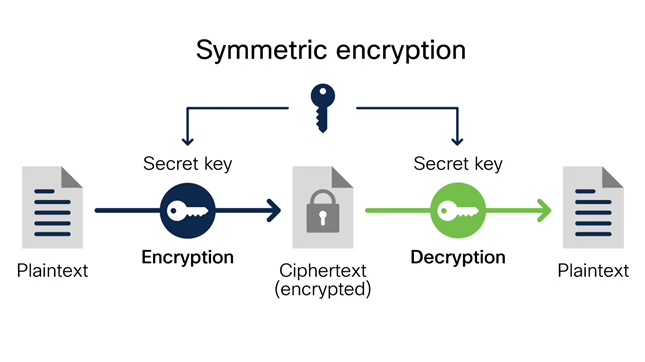
Symmetric encryption uses the same key for encryption and decryption. Due to the speed of encryption that this process offers compared with asymmetric approaches, symmetric key encryption is typically used for encrypting larger amounts of data. A commonly used symmetric encryption standard is Advanced Encryption Standard (AES). The confidentiality of the encrypted data is only as good as how well the key is protected from unauthorized users.
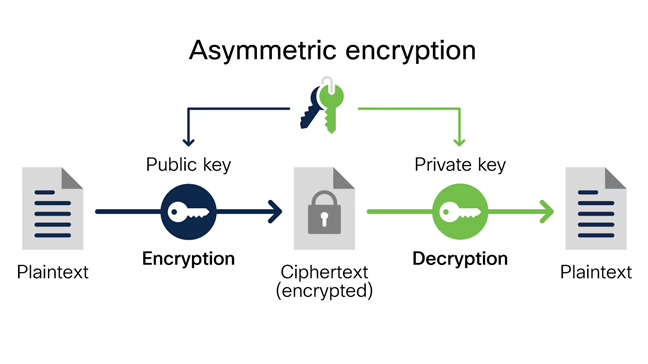
Asymmetric encryption generates two separate keys: a public key and a private key. Each pair of keys has two important properties:
Data encrypted with the public key can only be decrypted by the private key (and not even the public key). This property makes public key cryptography ideal for when data needs to be securely and privately delivered to a recipient.
A digital signature created with the private key can be verified with the public key. This property allows public key cryptography to be used for strong authentication.
In practice, end-to-end encryption relies on well-known encryption algorithms and broader encryption standards that define how those algorithms are used in real systems. Common algorithms include symmetric ciphers like AES (Advanced Encryption Standard), which use one shared key to encrypt and decrypt data quickly, and asymmetric algorithms like RSA and elliptic curve cryptography (ECC), which use public/private key pairs to establish secrets and sign messages.
An encryption algorithm is the mathematical recipe for scrambling and unscrambling data, while an encryption standard (such as TLS for secure web traffic or the Signal Protocol for messaging) specifies which algorithms to use, how keys are generated and exchanged, and how messages are formatted and authenticated.
For everyday users, this distinction matters because strong algorithms can still be undermined by a weak or outdated standard, whereas modern, well-designed standards combine multiple vetted algorithms to deliver practical, end-to-end security in apps you can use without thinking about the underlying maths.
End-to-end encryption greatly increases the effort required for an attacker to read your data because intercepted traffic looks like random data and stolen or leaked server data is similarly unreadable.
Attackers would need to break modern cryptography or compromise your device directly, both of which are significantly harder than targeting unencrypted services.
E2EE reduces the amount of content that can be:
It doesn’t make you invisible online, but it limits how much of your private life is laid open to analysis without your consent.
Knowing a service uses end-to-end encryption can:
For a growing number of users, “end-to-end encrypted” is now a key decision factor when picking messaging apps, password managers, and cloud storage.
It’s important to understand the limits:
End-to-end encryption protects the content of your communication, not every aspect of your digital footprint.
Marketing phrases like “We use strong encryption,” “Your data is secure,” and “Bank-grade” or “military-grade encryption” do not guarantee end-to-end encryption. What you want to see is language along the lines of:
If a service avoids being clear about this, assume it might only encrypt data in transit or at rest on their servers, not end-to-end.
In-transit encryption
This protects your data while it’s moving across the internet. For example, when you log into your bank or shop online, TLS/SSL scrambles your info so hackers can’t intercept it mid-flight. Think of it like sending a letter in a sealed envelope through the post: someone might see the envelope, but they can’t read what’s inside.
At-rest encryption
This protects your data when it’s sitting on a server, your phone, or your laptop. For example, your cloud storage or phone files are scrambled, so even if someone steals the device, they can’t access your data without the key. Think of it like locking your letter in a safe until you’re ready to open it.
End-to-end encryption often appears in policy debates because:
Despite these pressures, the broader industry trend is towards more end-to-end encryption in mainstream consumer tools, not less.
A backdoor is a built-in way to bypass encryption. The core problem is:
Most independent security experts argue that strong, unbroken encryption is essential for modern life: banking, healthcare, business, journalism, and everyday communication.
Depending on the laws in different countries, you might see:
For most people, a straightforward rule works well:
This reduces the chance of accidentally sending sensitive information through unencrypted channels.
Manage backups carefully
Backups are often overlooked:
Check whether your chat or cloud app offers end-to-end encrypted backups.
If not, be aware that unencrypted backups may expose content you thought was private.
Consider disabling non-encrypted backups for especially sensitive conversations or documents.
Make sure you also securely backup the keys used for E2EE since if you lose them then you lose access to all your encrypted content.
Because end-to-end encryption assumes your device is trustworthy, basic device security is critical:
If someone gains full access to your device, they can often read messages before they are encrypted or after they are decrypted.
End-to-end encryption is one part of a broader privacy and security toolkit. If you’re comparing privacy tools, consider how else to protect your communications and browsing.
End-to-end encryption is no longer a niche, technical feature; it underpins how safe your daily digital life really is. For most of us, the essentials are:
If you treat end-to-end encryption as a standard requirement rather than a luxury, you’ll be in a much stronger position to keep your private life truly private online.
End-to-end encryption is legal in most countries and widely used in:
Banking and financial apps
Secure messaging and email
Business, healthcare, and government systems.
Some jurisdictions impose regulations or restrictions, and there are ongoing political debates, but ordinary consumers using encrypted messaging apps or encrypted backups are generally acting within the law. If you’re working in a highly regulated field, follow your organization’s policies and any local industry rules.
If you send any information you wouldn’t want a stranger reading (e.g. bank details, private photos, work documents, personal conversations), then yes. End-to-end encryption protects your messages from hackers, data breaches, and even the app company itself. It’s not about having “something to hide”, it’s about keeping control over who sees your private information. In 2026, with data breaches happening constantly and your personal info being sold by data brokers, E2EE is basic digital protection, not paranoia.
Not easily. End-to-end encryption itself is extremely hard to break with current technology. Most successful attacks don’t crack the encryption, they target easier vulnerabilities like your password, your device (through malware), or trick you into revealing information (phishing). The actual encryption math is solid. Your best protection is using strong passwords, keeping your device secure, enabling two-factor authentication, and not clicking suspicious links. Think of it this way: E2EE locks your messages in an unbreakable safe, but if someone steals the key off your desk or tricks you into handing it over, the safe doesn’t matter.