Mobile wallets have evolved into core infrastructure, connecting identity, access, and credentials in a single programmable layer. In 2026, they are the default interface for digital life. For enterprises, not having a digital wallet strategy increasingly means falling behind.
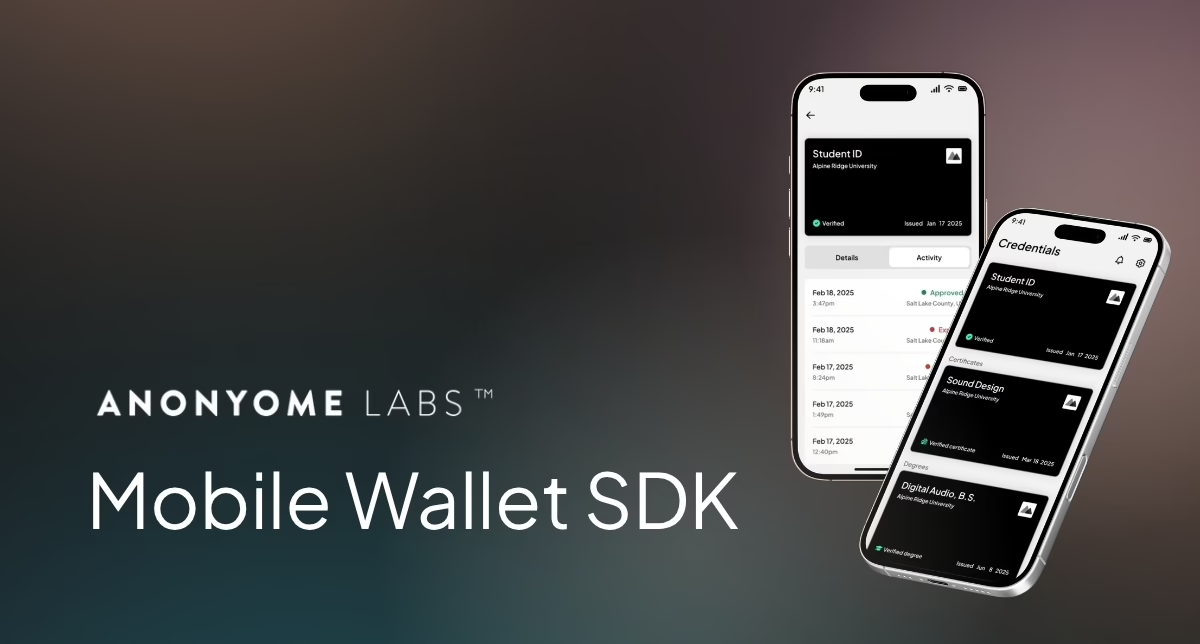
Anonyome Labs proudly offers the most advanced decentralized identity mobile wallet SDK on the market. It lets our customers easily integrate decentralized identity (DI) and verifiable credential (or reusable credential) solutions into their applications. It is a native SDK for both iOS and Android and does not rely on any third-party frameworks such as JavaScript frameworks.
With our 3.2 release just out the door, we’re excited to announce the release of version 3.3. Version 3.2 added hardware security module (HSM) support in alignment with EUDI requirements. Now version 3.3 goes further by graduating foundational protocols from draft to ratified standards, and expanding the range of credential formats the SDK supports. The result is a more mature, interoperable SDK that keeps pace with a rapidly evolving DI ecosystem.
Technical specs of Anonyome’s Mobile Wallet SDK v.3.3
OpenID4VC 1.0: from draft to ratified standard
Previous releases of our mobile wallet SDK implemented draft versions of OpenID for Verifiable Credential Issuance (OpenID4VCI) and OpenID for Verifiable Presentations (OpenID4VP) – two of the most important protocols underpinning modern DI ecosystems, including the European Union Digital Identity (EUDI) framework. With our SDK v3.3, both protocols have been upgraded to their final 1.0 specifications.
Graduating from draft to ratified standard matters. It gives our customers confidence that the protocols they’re building on are stable, broadly adopted, and aligned with global deployments. As part of this upgrade, we have continued testing against available interoperability test suites, including the OID4VP 1.0 conformance suite, as part of our ongoing commitment to standards alignment. We have also validated and maintained interoperability with real-world issuer and verifier software, including Credo 0.7.x, ensuring the SDK works reliably within the wider DI software ecosystem our customers are building against.
Broader credential format support
A major focus of version 3.3 is expanding the range of verifiable credential (VC) formats the SDK can accept and present. Building on existing support for W3C VCDM 1.1, W3C LDP signed VCs, IETF SD-JWT VCs, and AnonCreds, this release adds:
- W3C Verifiable Credential Data Model (VCDM) 2.0: This is the latest W3C data model for verifiable credentials, used extensively throughout the industry, such as in education credentialing.
- vc+sd-jwt (SD-JWT wrapped W3C VCDM): The vc+sd-jwt credential format combines the selective disclosure capabilities of SD-JWT with the W3C VCDM, allowing holders to share only the specific credential attributes a verifier requires.
Both VCDM 2.0 and vc+sd-jwt credentials are transportable over OID4VP and OID4VCI via their respective credential format suites, meaning customers can receive and present these credentials across the full OpenID4VC protocol stack. For a full list of supported credential formats and protocols, see our SDK documentation.
OID4VCI authorization code flow
Previous releases of the mobile wallet SDK supported only the OID4VCI pre-authorized code flow, which is suited to scenarios where the issuer has already authenticated the user out-of-band. SDK v3.3 adds support for the full OID4VCI authorization code flow, where the issuer authenticates the user, via their OAuth authorization channel, as part of the issuance process.
This unlocks a broader set of real-world issuance scenarios, particularly those where the issuer needs to verify the user’s identity at the point of credential issuance, rather than relying on a prior authentication step. It’s an important addition for customers deploying the SDK in more complex production environments.
What’s next for Anonyome’s DI mobile wallet SDK
As always, Anonyome Labs will continue to closely track the evolution of DI standards and push regular updates to keep the mobile wallet SDK at the leading edge. To learn more about our DI mobile wallet SDK and how it can power your verifiable credential solution, get in touch with our team.
FAQs: digital wallets for enterprises
What is a digital wallet?
A digital wallet is a secure, app-based container that stores and manages identity credentials, access passes, loyalty cards, tickets, and more. Unlike a physical wallet, a digital wallet is programmable, verifiable, and under the user’s control. For enterprises, it represents a platform layer: a single point of engagement that connects who your customers are, what they own, and what they’re entitled to, all in one seamless experience.
In 2026, digital wallets are core infrastructure, combining identity, loyalty, access under one product experience. They are no longer a convenience feature. They are becoming the default interface for digital life, and the foundation for giving people genuine control over their own data.
What can enterprises do with a mobile wallet SDK?
A mobile wallet SDK gives enterprises a ready-built toolkit to embed wallet functionality directly into their existing mobile apps, without building from the ground up. Key capabilities include:
- Identity and access – receive verifiable digital IDs, employee badges, and membership credentials; enable scan-to-access for physical and digital environments
- Loyalty and rewards – receive and manage digital loyalty cards, push personalized offers, and track redemption in real time
- White-labelling – launch a fully branded wallet experience customized for a vertical (e.g. retail, healthcare, travel, finance) and significantly reduce time-to-market.
The result is that enterprises can monetize, engage, and secure digital interactions across their customer or employee base from a single, scalable platform, while putting users in control of what they share and with whom.
What is decentralized identity and why does it matter for enterprises?
Decentralized identity (DI) is a model in which individuals own and control their identity credentials without relying on a central authority like a government database, bank, or platform to verify who they are. It is built on three components:
- Verifiable credentials (VCs) – digitally signed, tamper-proof certificates such as passports, qualifications, or age proofs
- Decentralized identifiers (DIDs) – unique identifiers anchored on a blockchain/distributed ledger or file system
- Digital/mobile wallets – the secure container where credentials are stored and selectively presented.
For enterprises, decentralized identity means faster, cheaper, and more trustworthy verification without maintaining centralized identity databases that are costly to manage, difficult to keep current, and attractive targets for breaches. Critically, it means personal data stays with the person it belongs to, not in your systems.
What is the link between mobile wallets and decentralized identity?
Mobile wallets are the natural delivery mechanism for decentralized identity. They already store sensitive data, authenticate users with biometrics, and share information at the point of need – the same functions required for identity verification. When combined with decentralized identity standards, a mobile wallet becomes a personal identity vault: your customer or employee holds their own verified credentials and presents only what’s required, to whom they choose, without any central authority in the middle.
In practice, this means:
- Issuance – A trusted authority (bank, government, university) issues a verifiable credential directly to the user’s wallet.
- Storage – The credential is held by the user, not stored in your systems.
- Presentation – The user shares only what’s necessary; for example, presenting only part of a credential (selective disclosure) and confirming they are over 18 without revealing their date of birth (zero knowledge proofs).
- Verification – Your systems verify the cryptographic signature instantly, without querying a central database.
This selective disclosure and zero knowledge proof capabilities is a significant privacy and compliance advancement for enterprises operating under CCPA, HIPAA, and similar US federal and state privacy frameworks. Verification happens directly between the wallet owner and your platform. No intermediary holds the data, and no centralized honeypot exists to be breached.
What are the real-world enterprise use cases for digital wallets and decentralized identity?
Across industries, the combination of mobile wallets and decentralized identity is already being deployed:
- Financial services – KYC completed once, reused across multiple products and partners without re-verification
- Healthcare – vaccination records, insurance credentials, and clinical certifications stored in-wallet and instantly verifiable
- Insurance – instant proof of insurance at the point of need, whether at a car accident, a clinic, or a border crossing
- Travel and hospitality – digital passports and visa credentials verified at border control or hotel check-in via a wallet tap
- Workforce management – verifiable employee badges enabling tap-to-access for offices, systems, and sensitive environments
- Retail and events – age verification, loyalty credentials, and event tickets managed from a single wallet without friction
- Education and professional licensing – degrees and certifications issued as verifiable credentials, shareable with employers in seconds
- Agriculture and supply chain – farm IDs, emissions data, and compliance credentials held by producers and shared directly with processors, retailers, and exporters.
You might also like:
KuppingerCole Greenlights Anonyome Labs’ Verifiable Credential Solution in $50B Future Industry